



An Apple employee buys ESPP shares at a 15% discount on a $50 offering price, $42.50 per share. The stock rises to $90 by the time she considers selling. She can sell immediately and pay ordinary income tax on the full spread since purchase. Or she can hold through both required holding periods and convert most of that gain to long-term capital gain at the federal level. For a California employee in the 35% federal bracket, the difference is approximately $6,000 in after-tax value on 1,000 shares. She makes this decision reflexively at most companies. Making it deliberately takes an afternoon.
What Is the Difference Between a Qualifying and Disqualifying ESPP Disposition?
Under IRC §423, a qualifying ESPP disposition requires holding shares for more than two years from the offering date (the first day of the enrollment period) AND more than one year from the purchase date (when the company bought the shares for you at the discount). Both clocks must run. A disqualifying disposition, selling before either period is complete, taxes the full purchase-date spread as ordinary income. A qualifying disposition caps the ordinary income at the lesser of the actual gain or the offering-date discount, with remaining appreciation taxed as long-term capital gain at preferential federal rates. For California employees: California taxes all capital gains at ordinary income rates regardless of holding period, so the benefit of qualifying treatment is federal only.
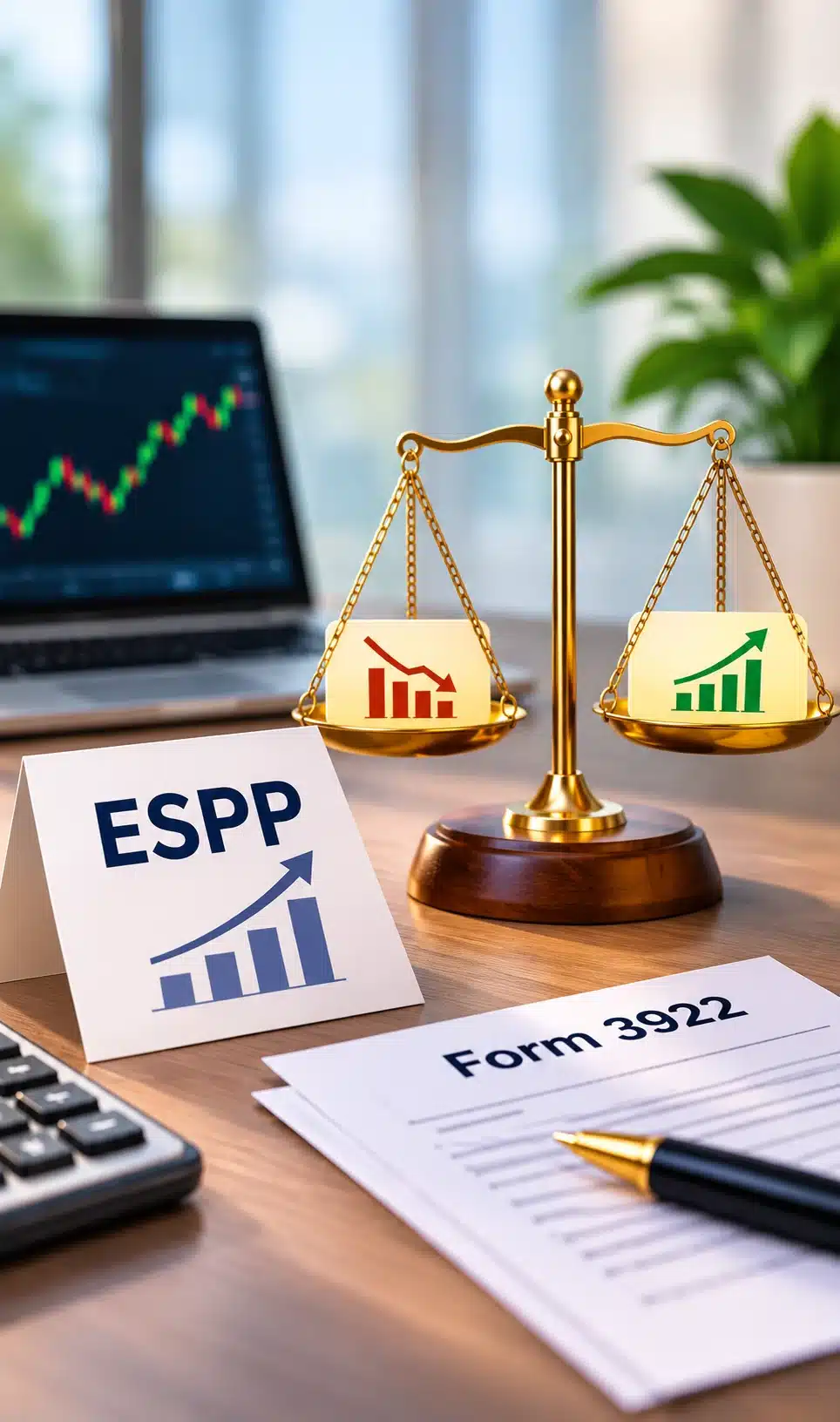
ESPP Form 3922 applies here. Your employer must issue Form 3922 for each ESPP purchase under IRC §423. This form documents the offering date, purchase date, and fair market values needed for ESPP tax calculations. Form 3922 applies to ESPP purchases only, not to RSUs, ISOs, or NSOs.
Who Should Read This
You participate in an ESPP at Apple, Cisco, Salesforce, IBM, Microsoft, AMD, or any California public company offering a qualified plan under IRC §423, and you have either sold ESPP shares or are deciding when to sell.
The Two Holding Period Requirements for a Qualifying ESPP Disposition
A qualifying disposition requires satisfying both holding periods, not just one. Selling more than one year after the purchase date but less than two years after the offering date is still a disqualifying disposition. This two-clock structure catches employees who track only the one-year rule and miss the two-year requirement for the offering date. Your Form 3922 shows both dates.
Why the ESPP Lookback Provision Matters
A lookback provision prices your shares at 15% below the lower of the stock price at the offering start or the stock price at the purchase date. If the stock was $50 at offering start and $80 at purchase, a plan with a lookback prices your shares at $42.50, 85% of $50, even though the stock is worth $80. Your immediate gain is $37.50 per share, not the $7.50 that a flat 15% discount would produce.
In a qualifying disposition with a lookback, the ordinary income is still capped at the offering-date discount, $7.50 in this example. The remaining $30 of appreciation is long-term capital gain at the federal level. This is the benefit the lookback provides: a larger spread treated as LTCG rather than ordinary income. That benefit exists only in a qualifying disposition.
How Does California Tax Qualifying and Disqualifying ESPP Dispositions?
California taxes long-term capital gains at ordinary income rates. A qualifying disposition converts federal ordinary income to federal long-term capital gain. California taxes both at the same rate. The $6,000 tax savings shown below comes entirely from the federal capital gains preference. California collects the same amount whether the disposition is qualifying or disqualifying.
Qualifying vs. Disqualifying ESPP Disposition: Side-by-Side Tax Calculation
California employee, 1,000 shares, $42.50 purchase price (15% discount from $50 offering price with lookback), stock at $90 at sale. Federal bracket: 35%. California rate: 12.3%.
Disqualifying Disposition (Sell Before Holding Periods Complete)
Ordinary income (purchase-date spread × shares): $37,500 → $37.50 × 1,000
Total gain: $47,500
Federal tax: $47,500 × 35% = $16,625
California tax: $47,500 × 12.3% = $5,843
Total tax: $22,468
Qualifying Disposition (Hold Through Both Periods)
Ordinary income: $7,500 (offering-date discount, capped)
Long-term capital gain: $40,000
Federal tax on OI: $7,500 × 35% = $2,625
Federal tax on LTCG: $40,000 × 20% = $8,000
California tax (all ordinary): $47,500 × 12.3% = $5,843
Total tax: $16,468
Savings: $6,000, from federal preference only. California: identical either way.
The Stock Decline Risk of Holding ESPP Shares
The qualifying disposition saves $6,000 in this example, but requires holding a concentrated position in your employer’s stock for up to two additional years. If the stock declines 15% during that holding period, the market loss on a 1,000-share position is $6,750, more than the tax savings. The tax benefit does not insulate you from market risk. Model both outcomes before deciding: the tax-optimal choice is not always the financially optimal choice when stock price risk is material.
The ESPP Cost Basis Trap
The same cost basis problem that affects RSU shareholders affects ESPP participants. When you sell ESPP shares, your Form 1099-B may report only the purchase price as your cost basis, omitting the ordinary income already recognized at sale. Filing without a Form 8949 adjustment produces double taxation on the ordinary income component. Form 3922 documents the figures needed to make this adjustment. Verify your basis at every sale.
What Does Capital Tax Do for ESPP Participants?
Capital Tax models the qualifying versus disqualifying disposition outcome for each client’s specific income level, discount rate, lookback provision, and California situation, factoring in both the federal tax savings and the stock price risk of extended holding. We also review Form 3922 against the Form 1099-B at filing to catch and correct basis errors. We serve ESPP participants at Apple, Cisco, Salesforce, IBM, Microsoft, and AMD.
Begin Your ESPP Disposition Analysis
If you participate in an ESPP and have not modeled the after-tax difference between immediate sale and qualifying hold, begin your ESPP Disposition Analysis at capitaltax.com/tax-planning-for-executives. Bring your Form 3922, your current stock price, and your projected income for the year of sale.
Frequently Asked Questions About ESPP Qualifying and Disqualifying Dispositions
What is a qualifying disposition of ESPP shares?
A qualifying disposition occurs when you sell ESPP shares after holding them for more than two years from the offering date and more than one year from the purchase date. Meeting both holding periods allows you to receive favorable federal tax treatment on the gain.
What is a disqualifying disposition of ESPP shares?
A disqualifying disposition occurs when you sell ESPP shares before meeting either of the two required holding periods. The purchase-date discount is generally treated as ordinary income, while any additional gain or loss is treated as capital gain or loss.
How long do I need to hold ESPP shares to qualify for favorable tax treatment?
You must hold ESPP shares for more than two years from the offering date and more than one year from the purchase date. Both requirements must be satisfied to qualify for favorable federal tax treatment.
How are qualifying ESPP dispositions taxed in California?
California taxes capital gains at ordinary income tax rates, regardless of how long you hold the shares. Therefore, qualifying ESPP dispositions generally provide a federal tax advantage but do not receive preferential capital gains treatment at the California state level.
What is the difference between Form 3922 and Form 1099-B for ESPP shares?
Form 3922 reports important ESPP purchase information, including offering dates, purchase dates, and fair market values. Form 1099-B reports the proceeds and cost basis of shares sold. Both documents are useful when calculating the correct tax treatment of ESPP transactions.
Does a qualifying ESPP disposition always result in lower taxes?
No. Although qualifying dispositions can provide favorable federal long-term capital gains treatment, holding shares longer exposes employees to stock market risk. A decline in the company’s share price could outweigh the potential tax savings.
How is the ESPP lookback provision calculated?
A lookback provision allows employees to purchase shares at a discount based on the lower stock price between the offering date and purchase date. For example, if the offering-date price is $50 and the purchase-date price is $80, a 15% discount results in a purchase price of $42.50.
Can I correct an ESPP cost basis error on my tax return?
Yes. If Form 1099-B reports an incorrect cost basis, you can generally correct it using Form 8949. Form 3922 provides the purchase information needed to calculate the appropriate basis adjustment and avoid double taxation.